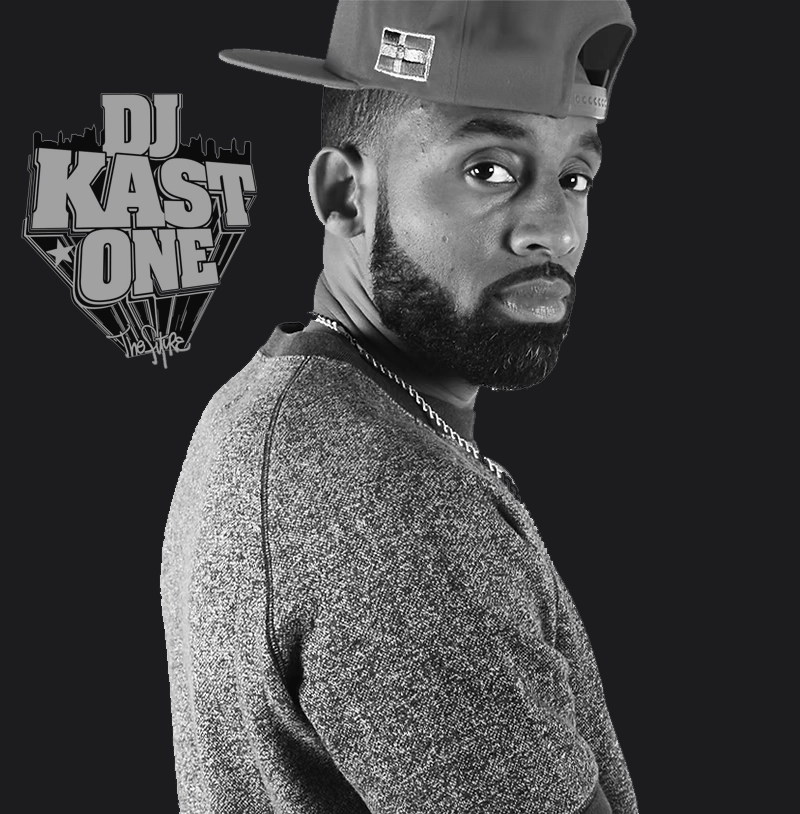
We connected with Kast One, who shared the airwaves with us back in 2005 on Sirius Satellite Radio, to talk about what vinyl means to him, how DJ culture has shifted, and what independent artists need to understand before they press their first record. Today he is on the boards every morning for Hot 97 Mornings with Mero alongside his old Bronx friend The Kid Mero. From satellite radio in 2005 to Hot 97's morning slot in 2026. The grind never stopped.
When did vinyl first become serious to you as a collector? Was there a specific record that hooked you?
I guess that would be when I really kind of started playing out. DJing out was really when it started becoming serious for me because before that, I would just have records around the house or whatever. But when I started having to bring those records out and making sure that they weren't skipping everywhere, making sure I had every record that I needed, and going back and finding stuff that I never thought I would need — like original Prince records and Bootsy Collins records and all those type of classic joints, besides the hip-hop records — that's when it kind of became serious for me.
And the record that hooked me was actually Biggie's first single, Juicy. It was Juicy on one side and Unbelievable on the other side. I actually went looking for the record with him and Method Man, and that wasn't even out yet. It was only the Unbelievable joint. So I was like, let me just get that record right there. And that one right there, that hooked me, man. I was on it after that.
Thinking back to the mixtape era and our radio show in 2005: what stands out most about that time?
I think it was pretty much the grind, bro. It was a hustle. I loved it. I love the grind. I love the hustle. I love trying to get records before everybody else had them. I loved coming up and doing the show and counting down everybody else's mixtapes to see who was killing and who wasn't. What really stood out to me about that era, and what I really enjoyed, was the hustle, man. You had to be on it. You had to go hustle out there. If you wasn't going to get it, you wasn't going to get it.
That answer lands the same way it did back then. The show was built on exactly that energy. Nobody was waiting for permission, nobody was waiting for a label to tell them what was hot. You either had the record or you didn't.
How has DJ culture changed since the mixtape era? What's stayed the same?
It's a completely different ballgame right now. Completely different. Everything's changed. First of all, we're not even using records and CDs anymore. We're on computers using laptops, and soon that's going to be gone too, because it's going to be iPhones and USBs. So technology-wise it's changed a lot. The way people perceive DJs has changed a lot.
What's stayed the same? You still have to work. The work may not be the same — you may not have to go out there and nickel and dime and get it popping — but you still have to work, bro. You got to be on social media. You got to find a way to get yourself out there. Instead of mixtapes, people upload their mixes onto all these servers and platforms. The hustle is still there, but the actual methods of delivery have changed.
What makes a vinyl release feel authentic versus a cash grab today?
I think what makes a vinyl release authentic is when you tie it to something — when you tie it to an anniversary, or you tie it to some sort of event. Or if it's a special version of the album, something with an extra bonus track on it, or different colors. I think all of that counts toward it being authentic. And also when the artist is involved. A lot of companies put out vinyl and don't even involve the artist. But when the artist is involved, that right there feels fire.
Have you seen artists underestimate what collectors actually value? If so, how does that show up?
I have seen artists underestimate collector value, but I also think that a lot of artists are coming around to the idea that collectors and superfans are super important and they should be super-serving them. When artists figure out that they don't need to target everybody — they could just do things for their superfans who are going to be there and support them throughout thick and thin — that's where they usually aim all of their efforts. So I think right now they're kind of figuring that out.
When you're selecting records for your crate, what signals to you that a project is worth investing in?
When it's hot. If the song is fire and it's hot out there and I know I'm going to have to play it, I'm more apt to go buy it. I'm not just going to get something just to have it in the crate and never use it. If it's something that's fire, it makes it to the crate. If it's not fire, it don't make it to the crate.
How much influence do fellow DJs have on your collecting decisions?
Not much, because I usually buy what I like, or I buy what's hot out there, or what I think is going to move the crowd. But there's always things that you're going to put somebody onto, or somebody's going to put you onto, that you didn't know or wasn't seeing. So there is some influence there from fellow DJs, especially DJs that you're close to and talk to a lot. You share information. And you might find something that you didn't know about.
If an independent artist wanted to press vinyl today, what advice would you give to make it genuinely collector-worthy?
Make it good. Make sure the sound quality is good. Make sure the artwork is good. Make sure you have all the credits on there and it looks good. Those are the three first things. Anything after that is whatever — if you want to do a color vinyl, if you want to do some designs on the vinyl, that's all cool. But you got to make sure that cover's right. You got to make sure that sound is right, that pressing is clean. That'll make it collector-worthy. And if it's amazing, there you go.
Last question — who or what should mixtapekings.com spotlight next in this series?
I think you guys should absolutely spotlight somebody like LaRussell, who is making moves independently and teaching a master class to artists on how they should be moving into the future.
That co-sign lands. LaRussell has been doing it independently, consistently, on his own terms. When a DJ with Kast One's ears points somewhere, the signal is worth following. The series is already building toward its next conversation.
DJ Kast One is a Bronx native, a Heavy Hitter, and the DJ holding it down every morning on Hot 97 Mornings with Mero. From Cedar Park to satellite radio to the most storied hip-hop station in New York. The crate has been with him every step of the way.
Collector Spotlight returns next month. If you know a DJ, collector, or curator whose perspective deserves a platform, let us know.
Get Early Access →